


Lydia's Shabbat (Acts 16)
- Cara
- Nov 14, 2020
- 5 min read
One of the reasons I began this series was to debunk the myth that women were second fiddle in God's plans. A little more investigation has revealed to me some pretty amazing truths about God's love for women and his inclusion of them in the incredible work of reconciliation of humanity.
In this story we find Paul and Silas were on the road again with their navigator, the Helper. They had just picked up Timothy in Lystra and their plan was to catch up with the small communities of disciples that were popping up all over the place, encourage them and look for opportunities to share the good news about Yeshua's resurrection in new areas.
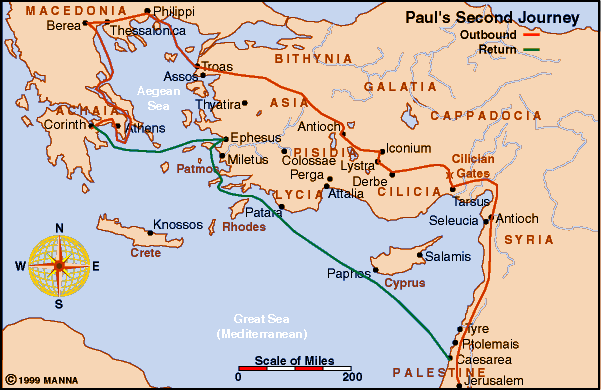
The team want to crack open some new ground over in Bithynia but the Helper 'prevents them'. They head over to Troas and after a dream of a Macedonian guy calling for help, they Greek Island hop across Samothrace to Neapolis then overland to Philippi (modern city of Filippoi Φίλιπποι, Greece).
Philippi is a Roman colony and the capital city of that region of ancient Macedonia. Whilst Paul's calling was to share the message of Jesus with the Gentiles (non-Jews), he would often scout out the local Synagogue on Shabbat (the customary day of rest and gathering of those who believed in YHVH).
Jewish people were scattered all throughout the modern world but you would often find Gentile converts (referred to sometimes as God-fearers) or non-Jews who perhaps hadn't taken on the Jewish faith but were interested in learning more about the Creator who had revealed himself to the Hebrews as YHVH.
The three are in Philippi a few days, hanging out at the marketplace, catching up on news and talking with locals to find out where the Jewish meet-up was... outside the city gate near a river. It was customary to be near water for the purposes of Mikvah, the ceremonial washings that Jewish folk would undertake at certain times as an outward sign of renewal, repentence, cleansing, a new season. The original Greek for 'place of prayer' is proseuchē προσευχή (transliteration: proseuchḗ, pros-yoo-khay). According to this concordance link a place of prayer was usually either a synagogue or a place in the open air where the Jews gathered for fellowship and prayer, outside the cities, where they had no synagogue.
I'm hoping the place of prayer we read about in verse 13 was somewhere like this....

Acheron River, Fanari, Preveza, Epirus, Greece
(photo credit www.trekearth.com)
ps. have I whet your appetite for a visit to Greece??
So on Shabbat (the day of rest) the crew head down to the place of prayer and start talking with folk that are gathered there. We don't really know who else was there but we do know that they spoke with a group of women, amongst whom was Lydia, a dealer in purple cloth, originally from Thyatira (a city back across the Aegean sea in the region that the Helper had 'prevented them' from visiting a few weeks back).
Thyatira stood on the border between Lydia and Mysid (modern-day Turkey) so whether this woman's name is actually Lydia or just a reference to where she is from may be a question mark. I say that only as a passing comment because I looked up Paul's follow up letter to the Philippians to check whether she is referenced in the closing greetings.

[the above pics are just some images from Google]
I thought she might be (given what unfolds) but could not find her there.
I just want to pause and explore Shabbat ( שַׁבָּת) a little more for those of us maybe unfamiliar with the practice. The Jewish community end their working week at sunset on Friday evenings to take time out to rest, spend time with family and loved ones and spend time with other Jewish folk in their homes and at the Synagogue. This concludes on Saturday evening. A good summary of Jewish Shabbat is here.
Most people may be familiar with Shabbat from the fourth commandment which basically says remember the Shabbat day to keep it holy, just as God rested on the seventh day, so shall we rest from our work. It is also the gift God has given us to remember we are more valuable than our work, not to get too hung up on it and not to let it run our lives.
We are no longer slaves in Egypt, we are called to be children of God, to live wild under the stars, to be... free!
Whilst the captivity in Egypt really happened, some folk see it as underscoring something more important; the nature of humans to get lost in our work, to seek value and identity from what we can achieve, from our knowledge, our power, a search or treadmill really which is unending; rather than resting in our true identity as children of the Creator. You can track it back to the garden of Eden when the first couple had a special relationship with God, there was no fear or shame and they walked with Him each day in harmony. Then came along Satan in the form of a snake and put doubt in their minds towards their Creator giving them the idea that knowledge and power was better than trust and relationship. This is part of the broken relationship with our Creator that He pursues us to restore; the reason He came as Messiah, the anointed one, fully man and fully God, Yeshua (Jesus) to rebuild that trust with us, to bridge the rift and to go before us across the veil. The one the Hebrews had been waiting for, the promised one promised in so many prophecies, had arrived to restore the relationship with our Creator that could never be achieved by human striving.
As I pondered the story I made some assumptions about Lydia including that she had been studying about YHVH for some time and set time aside from her life to observe Shabbat. Whe took time out from her busy schedule to make time to be with other Jewish folk, to learn, to seek God. We don't know how long she had been part of this Jewish community, or where and why her journey to know God began (all things I would like to ask her one day). She was clearly a smart and savvy business woman (purple cloth was an expensive luxury item back then, in demand with Roman officials and royalty), she was the leader of her household and a woman of influence but she also showed humility and was open to listening to what Paul and the team had to share. We she heard the message that the Messiah had finally arrived in the person of Yeshua, and that he had completed healing work at Calvary and that God had proven his position by raising him to life, she was ready to accept Him immediately. We see that she and those in her influence immediately took Mikvah (baptism) as a testimony to their acceptance of Christ and she also offers the hospitality of her home for the team to stay and spend more time to share more with them all.
So it appears that Lydia may have been the first European based disciple of Yeshua that we read about in the New Testament and that the story did not end with her! Lydia was a faithful disciple who not only established a base for the gospel from her home but was a key person the thriving community of disciples that was established in Philippi. Lydia you are one incredible woman and today as I remember you I am thinking about your example:
You observed Shabbat,
You were open to the word shared with you about Yeshua;
You said yes and you dived in, fully clothed in purple and all!
God bless you friends, I pray Shabbat would also bless your life!
Shabbat shalom!


Comments